
You’re spending real money on Google Ads. You’re getting clicks – you can see them in the dashboard, day after day, week after week. But the phone isn’t ringing as often as you’d like. The enquiry form submissions are thin on the ground. Somewhere between someone clicking your ad and becoming a paying customer, something is going wrong, and you’re not sure where to look.
If this sounds familiar, you’re in the right place. In this article I’ll give you some “oven-ready insights” (to use a Boris Johnsonism) as to why that’s happening.
The Click Is Not the Destination
You’ve heard the expression “talk is cheap”. Well, in Google Ads, clicks are cheap. Well, they’re not actually, but stick with me. Here’s what I mean: getting someone to click on your ad isn’t all that hard.
The hard part is what happens next.
From the moment they land on your page, you have about three seconds to convince them they’re in the right place. If your landing page doesn’t immediately reflect what your ad promised, people bail. Not because they don’t need storage. But because you gave them a reason to doubt you.
Why Most Self Storage Landing Pages Leak Enquiries
I spent years before self storage working in flexible workspace marketing — with operators including Instant Offices (bought by Regus) and Argyll. These businesses had significant ad budgets and sophisticated marketing teams.
The number one lesson I took from that world: the landing page is where campaigns are won or lost, not the ad.
Self storage is no different. Here’s what I typically find when I audit a self storage Google Ads account that isn’t generating enough enquiries:
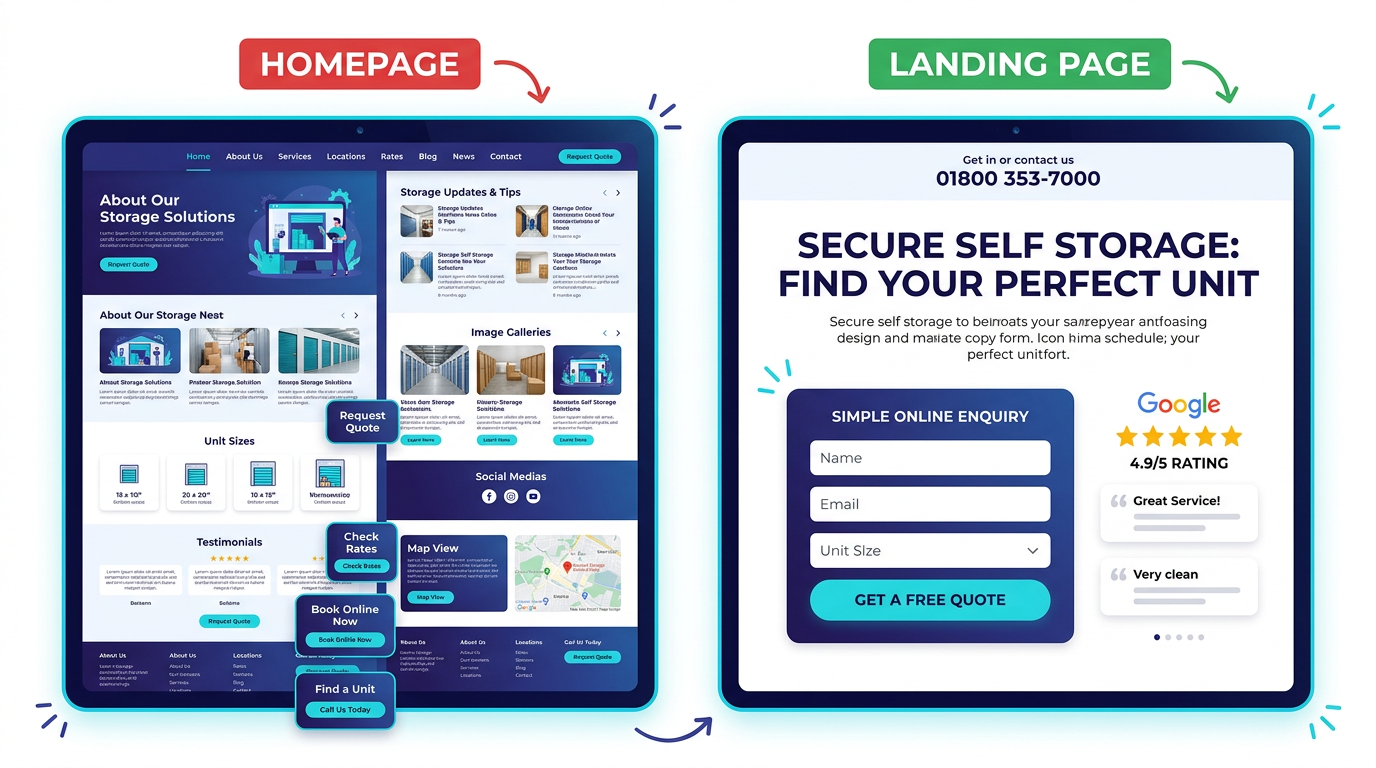
The ad sends traffic to the homepage
Your homepage is designed to tell everyone everything about your business. It is not designed to convert a specific type of visitor with a specific need. When someone clicks an ad for “self storage in Bristol,” they should land on a page about self storage in Bristol – not a homepage with a navigation menu, an about us section and a news feed. Less is more. Give people a reason to click away and they sure as anything will.
The messaging doesn’t match the search
If someone searches “cheap storage units near me” and your landing page leads with your company history, you’ve already lost them. The page needs to immediately answer the question in their head: is this the right place for me? Or in this example, is this really a budget option?
There’s no single, clear call to action
Too many pages ask visitors to do too many things at once — call us, email us, visit us, read our blog, follow us on social media. A conversion-focused landing page has one job: get the visitor to make an enquiry. Everything on the page should serve that purpose.
The page is hard to use on mobile
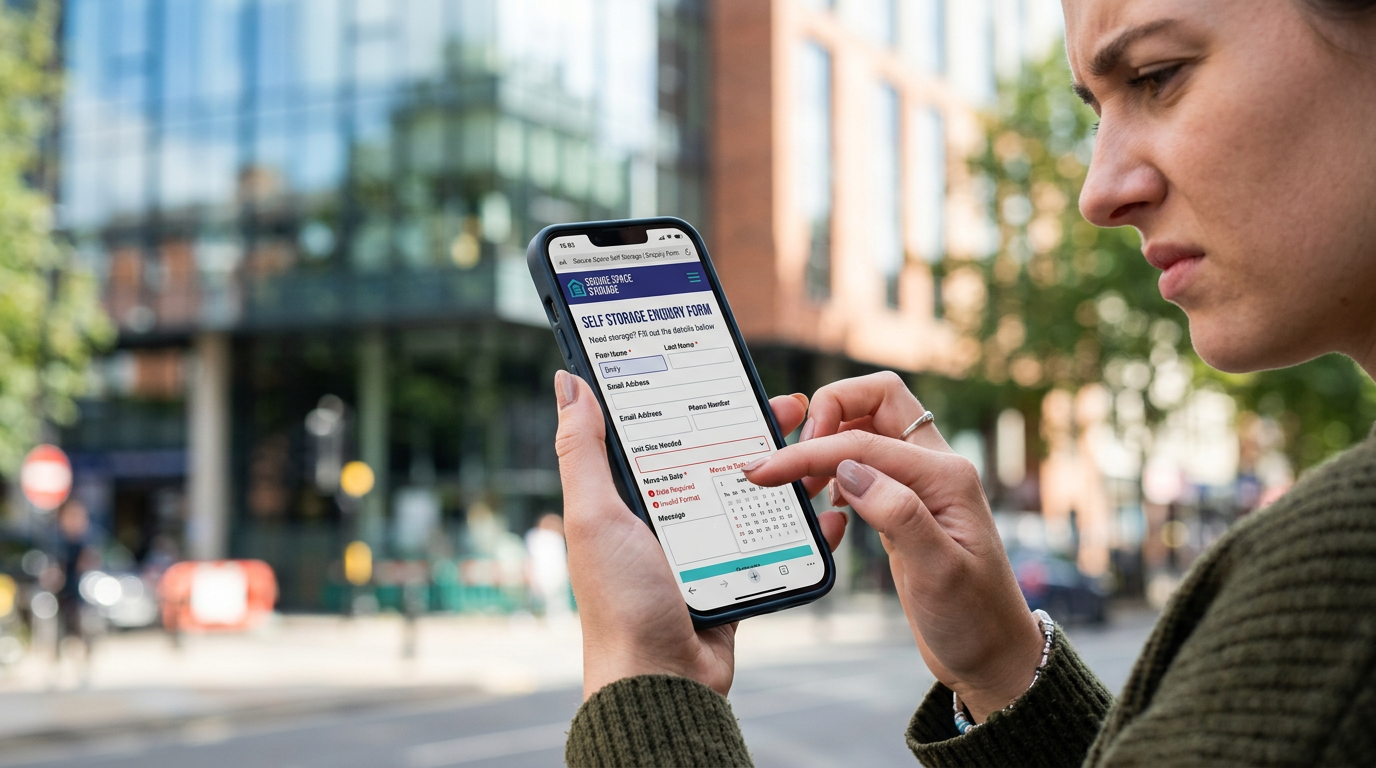
A good 75% of your enquiries will come via a mobile phone, so design for mobile at all costs. Most marketing agencies (and maybe founders) design while sat at a 25 inch high res apple monitor. While thats a lovely experience for them, with flat white and pastry sat to one side, it’s not how customers consume your content. You should design for mobile first, and desktop second. Don’t feel all smug about a desktop design and say “I’ve checked on mobile, it’s fine there”. Do the opposite. Make it look rad (apologies, that’s the 1990s kid in me) on mobile first, then check it looks good on desktop. Pay special attention of the enquiry form too – that is where wars are won or lost. Check different screen sizes too, not just the iPhone 17 max pro you happen to have at hand.
There’s no trust signal above the fold
Paid traffic are a odd bunch. Traffic from ads are ultra-cynical with finger hovering over the back button within seconds of opening your page. They don’t know you from Adam. You were at the top of Google in the sponsored links. They didn’t click on you because they love or respect your brand. They clicked because you nearest to the top and your ad made sense. In our experience, you need to pile on the social proof straight away. They need to see reviews, stars (5 ideally), to reassure them you’re trustworthy. We pull through Google reviews from the clients Google Business Profiles straight into the mobile nav bar – they’re more visible than the clients logo, that’s for a reason – they matter.
The Conversion Rate Problem in Numbers
Thankfully we have an easy way to determining whether a landing page is good at turning clicks into enquiries: conversion rate.
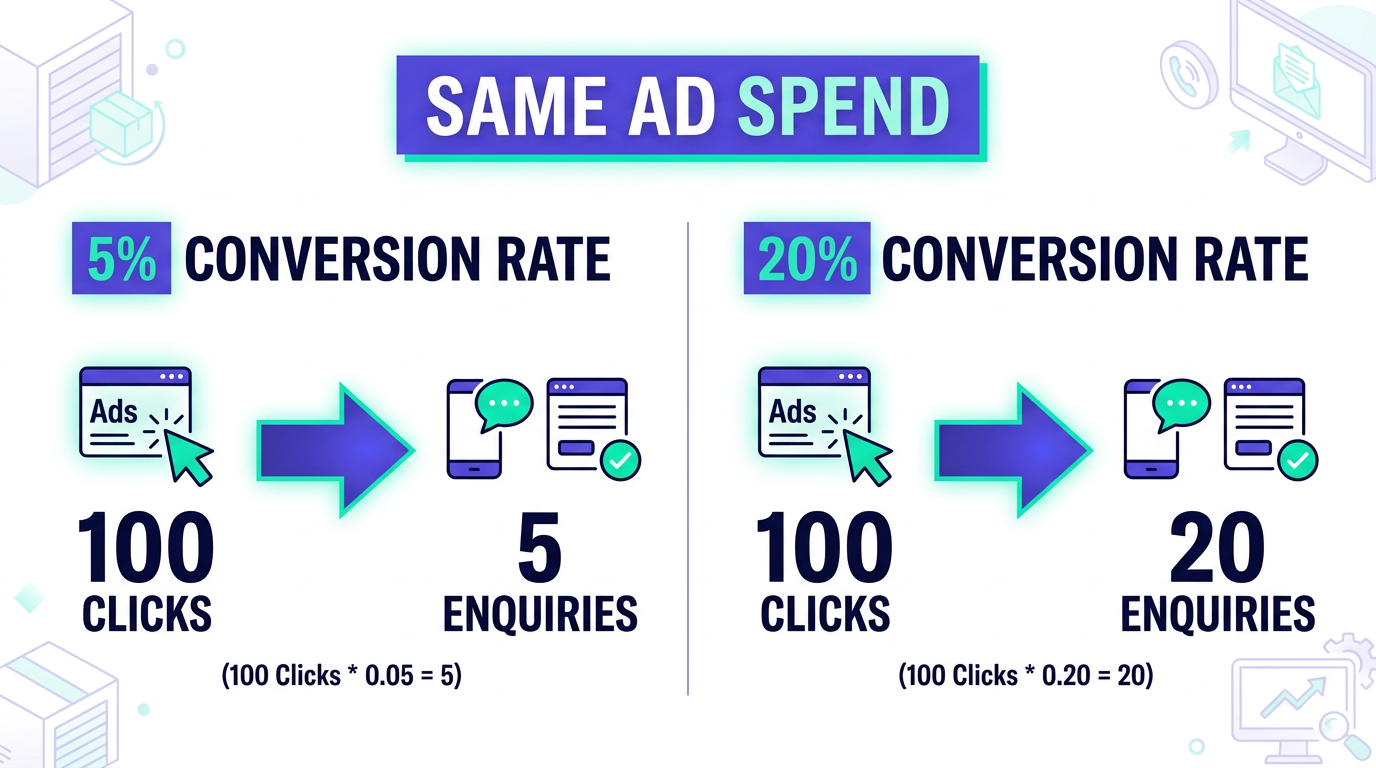
You get 100 clicks to your page, 10 enquire, that’s a 10% conversion rate. The typical conversion rate we find across accounts we audit is between 5% – 10%, often closer to 5% than to 10%.
We always aim to hit 15 – 20% conversion rate. Same ad spend, just double the result. We do this by incorporating all the above. Testing is also a big part of what we do…
Back to the world of flexible workspace briefly: when I worked for those big players mentioned above, we adopted a “marginal gains” mindset and were constantly testing new ideas to see how we could increase conversion rates. We’d get ideas from going to coworking spaces, sitting down with customers and asking them to use the site while we took notes. The issues were obvious when you observed how people used (and got frustrated) using your site. We’d take those ideas, design solutions to alleviate the frustration, then run an A/B test to see if that helped. In cases where the new idea generated more conversions, we’d roll that version out.
Well, we’re take the same approach to self storage. Find the issues, dream up improvements, test them and roll out the winners. That’s how to get to the realm of 20% conversion rate.
It’s Not Just the Landing Page
Aiming to get higher conversion rates is a must. But sadly, you’re not done.

Even when a visitor does decide to enquire, there’s another point of failure that most operators overlook: the response.
Self storage is a considered but relatively fast decision. When someone decides they need storage, they usually need it soon. They might have a house move coming up, a business clearing space, or a life event forcing them to act. They’re not going to wait three days for a reply.
If your enquiry form submission sits in an inbox overnight, or your missed call doesn’t get returned until the following morning, that lead is likely gone. Not because they found someone cheaper. Because they found someone faster.
In self storage, the early bird really does get the worm.
The operators who convert the most enquiries into actual move-ins are the ones who respond within minutes – not hours. An automated acknowledgement, a rapid callback, a follow-up message if the first attempt doesn’t connect. This isn’t complicated. But most operators don’t have it in place.
What a Properly Structured Campaign Looks Like
Without wanting to blow our own trumpet, when we build a Google Ads campaign for a self storage operator, the ads are only one part of the picture. The full system looks like this:
- Targeted search campaigns — focused on the specific search terms your ideal customers are using, with tight geographical targeting around your facility. Not broad match keywords that waste budget on irrelevant searches.
- Dedicated landing pages — built specifically for paid traffic, with location-specific messaging, a single clear call to action, mobile-optimised forms, and trust signals that convert visitors into enquiries.
- Accurate conversion tracking — so you can see exactly which campaigns, ad groups and keywords are generating enquiries, and which are burning budget without results. Without this, you’re flying blind.
- Lead response automation — so every enquiry gets an immediate acknowledgement and your team is connected to the prospect within minutes of them making contact.
Each of these elements relies on the others. Great ads sending traffic to a poor landing page won’t work. A great landing page with no tracking means you can’t optimise. Good tracking with slow lead response means enquiries go cold. The system only delivers results when all the parts work together.
What To Do Next
If you’re running Google Ads for your self storage facility and you’re not happy with the volume or quality of enquiries you’re generating, the answer is rarely to spend more money. It’s to look carefully at what’s happening to the traffic you’re already paying for.
Start with your landing page. Is it purpose-built for paid traffic, or are you sending clicks to your homepage? Does the messaging match your ads? Is there one clear call to action? Does it load quickly on mobile?
Then look at your tracking. Can you see, campaign by campaign and keyword by keyword, what’s generating enquiries and what isn’t? If the answer is no, you’re optimising blind.
Then look at your lead response process. What happens in the first 60 minutes after someone fills in your enquiry form or calls your number?
If any of those three areas have gaps, you’re leaving move-ins on the table every month.
Thanks for reading! Something to ask or add? Leave us a comment below like we’re in the golden days of the internet 😉
